

Certification and Our Engagement

Sustainability On Point
In 2025, we are set to provide a comprehensive and engaging understanding of the various dimensions of sustainability. We recognize that sustainability is a broad and multifaceted subject, and we will break it down in a way that empowers you to see your integral role in this critical journey. Over the past few years, we have made impressive progress together, and now we are committed to being more transparent about our journey with all of you. This month, we outlined the certifications and industry engagement within Triumph.
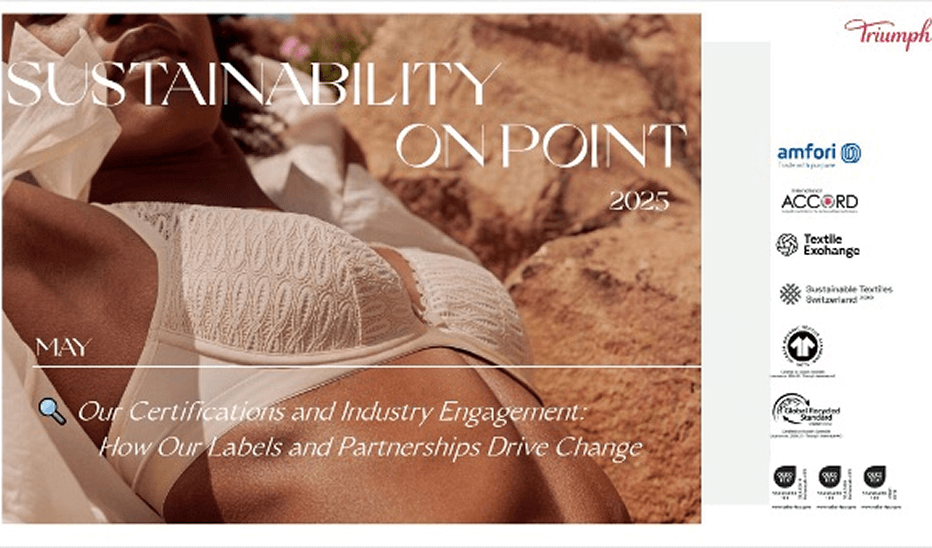
Certifications within Triumph
At Triumph, we are committed to enhancing the safety and quality of our products while advancing our sustainability initiatives. We have outlined the certifications integral to our organization.
OEKO-TEX® STANDARD 100
To safeguard the health of our customers from hazardous chemicals, we have adopted a strict chemical management program to restrict the use of harmful substances throughout our supply chain. To turn our commitment into action, Triumph has been certified to the OEKO-TEX® STANDARD 100 since the early 1990s.
What is OEKO-TEX® STANDARD 100?
OEKO-TEX® STANDARD 100 is a globally recognized, independent testing and certification system for textile raw materials, intermediate and finished products, and accessory materials. It is one of the most trusted labels for textile safety, certifying that products have undergone rigorous testing for harmful substances. This certification confirms that textiles have been evaluated for a wide range of harmful substances and are, therefore, safe for human health.
Why is OEKO-TEX® STANDARD 100 important?
Adopting OEKO-TEX® STANDARD 100 also ensures compliance with global regulations, including Annexes XVII and XIV of the REACH directive, CPSIA, and the ECHA-SVHC candidate list. The standard tests textiles for over 1,000 harmful substances, including those not regulated by law. The requirements of the standard are implemented globally across the Triumph supply chain. Internal and external audits ensure adherence to the standard. Product safety remains one of our top priorities, and we place great importance on maintaining high product quality while protecting the well-being of our customers.
GOTS and GRS
Since 2022, Triumph in Europe has been certified under the Global Organic Textile Standard (GOTS) and the Global Recycling Standard (GRS).
What is Global Organic Textile Standard (GOTS)?
The Global Organic Textile Standard (GOTS) is recognized as the world’s leading processing standard for textiles made from organic fibres. It also defines high-level environmental criteria along the entire organic textiles supply chain and requires compliance with social criteria. It also allows for the labelling of in-conversion products.
The entire supply chain from gin to end-product manufacturer should adhere to GOTS certification, and farm production should be certified according to organic production standards. This will improve our supply chain traceability.
What is Global Recycled Standard (GRS)?
The Global Recycled Standard (GRS) is a voluntary, comprehensive international standard. It covers all aspects of third-party certification of recycled content, chain of custody, social and environmental practices, and chemical restrictions.
By adhering to the GRS, we enhance supply chain traceability. Every stage of production is required to be certified, starting from the recycling stage and extending to the last seller involved in the final business-to-business transaction. This ensures that the entire process aligns with the Content Claim Standard.
Why are GOTS & GRS so important?
This is a continuous process, reflecting our commitment to transitioning our materials to minimize the impact of our products.
Any updates in Triumph regarding GOTS or GRS?
Following this significant success, Japan will be the next country in our pipeline to obtain the GRS certification. We expect to introduce the first GRS-certified series in SS26 to the Japanese market.
Triumph Industry Engagement
At Triumph, collaborating with industry leaders and organizations is pivotal to achieving our sustainability goals. We participate in global and regional initiatives to drive collective action and create impact. Engaging with key stakeholders amplifies our ability to address pressing environmental and social challenges.
By fostering strong partnerships, we can share knowledge, resources, and best practices that drive innovation and promote sustainable solutions. We recognize that addressing environmental and social issues requires a united front, and we are committed to actively participating in these initiatives. We have summarized our 4 major engagements in social, health and safety, product materials, and overall sustainability commitment. They are:
- Amfori BSCI
- International Accord for Health and Safety in the Textile and Garment Industry (Bangladesh)
- Textile Exchange
- Swiss Sustainable Textiles 2030
How are these engagements enhancing our sustainability performance?
Social and health & safety in our supply chain
amfori BSCI serves as a tool for us to safeguard the safety and rights of workers in manufacturing facilities in Triumph. As a committed member of amfori BSCI since 2012, Triumph actively encourages our suppliers to adopt the amfori BSCI code of conduct. Furthermore, we prefer to conduct BSCI compliance audits as part of our comprehensive supplier monitoring program.
Triumph is committed to ensuring the health and safety of every worker involved in the production of our products within our supply chain. This is the agreement signed in 2021 and renewed in 2023. Through our agreement with ACCORD, we have made significant strides in enhancing the structural integrity and fire safety performance of factory buildings, as well as improving the overall life safety and welfare of individuals engaged in our supply chain in Bangladesh.
Materials used in the product and involvement of the textile industry
Triumph is fostering a positive impact on our products through the adoption of alternative fibers, including certified recycled and organic materials. Our Textile Exchange membership, since 2022, enables us to take a holistic approach in exploring and integrating these alternative fibers throughout our supply chain, thereby reducing our environmental footprint from the source of the fiber.
The partnership with Swiss Sustainable Textiles and pledge to STS2030 in 2024 supports our goal of reducing environmental impact, enhancing transparency in our supply chain, and prioritizing responsible material sourcing. We believe that by collaborating with industry partners, we can drive innovation and foster lasting, positive change in the textile industry. Together, we’re committed to building a better future.